Stop, Look, Listen: How to Really Know Your Customers
The first thing any brand must do to be successful is to get insights about the people they want as customers, to understand their audience’s thoughts and behaviour so they can serve their unmet needs.
This is one of the basic truths about building a great brand:
the better the quality of your insights, the better your chances of becoming a powerful brand.
You’ve probably heard the phrase:
“Sell the right thing, to the right person, at the right time.”
At no time in history has that been more important. But that’s only possible if you know who that person is, and what “right” looks like for them.
So how do you actually get to know your audience?
How do you do research that gives you real insights, not just guesses?
This article is inspired by the book Brand Digital: Simple Ways Top Brands Succeed in the Digital World by Allen P. Adamson, especially the chapter “Stop, Look, and Listen: Get Insights About Your Digital Audience.” I’ll share the ideas I learned from it, plus some practical ways you can start using them in your own marketing.
Why focus groups and surveys aren’t enough
A lot of brands still rely on a very old, very passive way to do research.
You hire a research agency.
They bring in people.
You sit behind a glass window and watch them talk.
You get reports, surveys and interviews.
You spend a lot of time and money making “educated guesses” about what customers want.
Then you build products and campaigns on top of those guesses.
The problem?
It doesn’t always match real life.
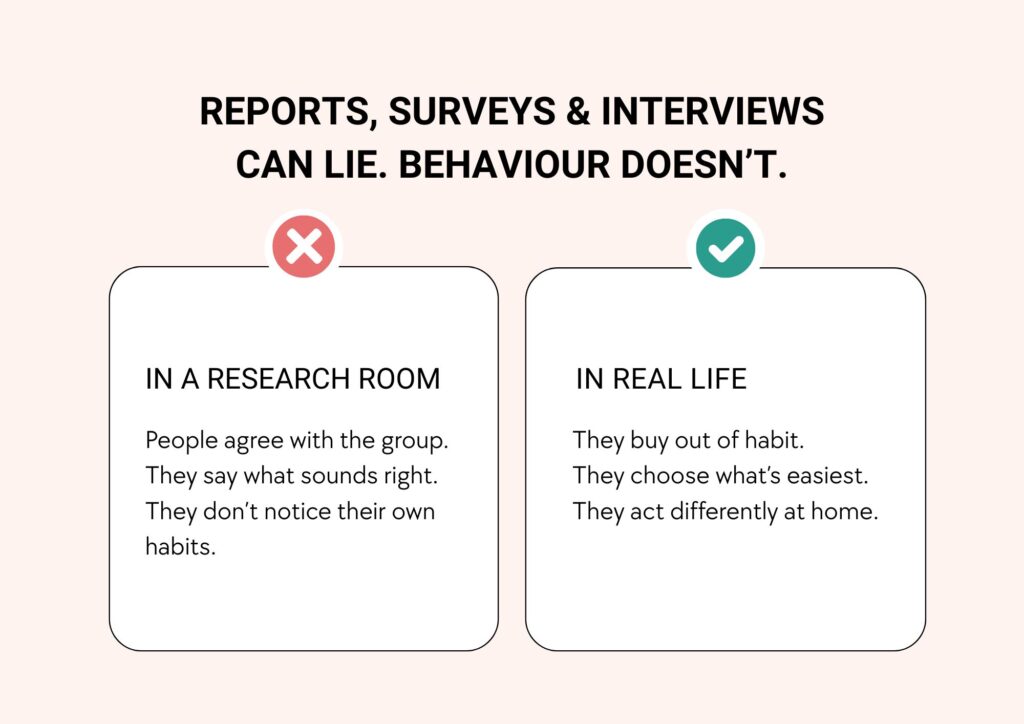
You can ask people questions in interviews or focus groups.
But that doesn’t mean you’re seeing what they actually do in their day-to-day life.
Even if you bring in someone who looks like your perfect target customer, there are risks:
- She might just agree with what the other nine people in the room are saying.
- She might tell you what she thinks you want to hear.
- She might not fully understand her own habits, so she can’t explain them clearly.
- She might say one thing in the room… then go home and do something completely different.
On top of that, many brands treat research as a once-a-year task.
You don’t only think about what your wife thinks or feels once a year. You listen as you go, as the relationship evolves.
It should be the same for brands. You listen and adjust as you go.
If we only rely on this old style of research, we risk building our strategy on what people say in a room, not on how they really behave in their everyday lives.
Use technology to get better consumer insights
Digital technology allows marketers to listen in on the millions of conversations taking place online every minute. They can see what’s being said on blogs, review sites and social networks. People talk about almost everything happening in their lives: celebrities, weather, politics, environmental issues, feeding the family, and much more. If anyone is talking about it, everyone else can see it and weigh in with an opinion.
The digital space doesn’t just show how people talk, it also shows how they behave, especially when it comes to their buying habits and activities. Marketers can observe, often in real time, what people are searching for, their buying process, how they compare products or prices, where they go for advice, which offers they find relevant, which product features interest them, and which sites they return to for more information or to make a purchase.
The wild part?
People share most of this with you for free through their searches, clicks, posts, reviews, photos and videos.
The ability to not just listen but to digitally watch consumers in action has massively improved the quality of insights we can get. If you learn how to use the right digital tools, you can stop guessing and start watching what your audience actually does in real life.
So how do you actually do that in your day to day marketing?
- Learn as much as you can about digital tools
- Create a listening culture
- Invite consumer input
- Identify your most influential online voices
Tools you can use to understand your audience
Use digital tools to do your research
Digital tools help you watch what people say and do.
They help you stop guessing and start seeing real behaviour.
A lot of research is already happening in public. People search, compare, complain, review, and ask questions online every day. Most of the time, they tell you what they want in their own words.
The easiest way to start is to set up a few tools that “listen” for you in the background, so you don’t have to manually check everything.
Google Alerts (free and easy)
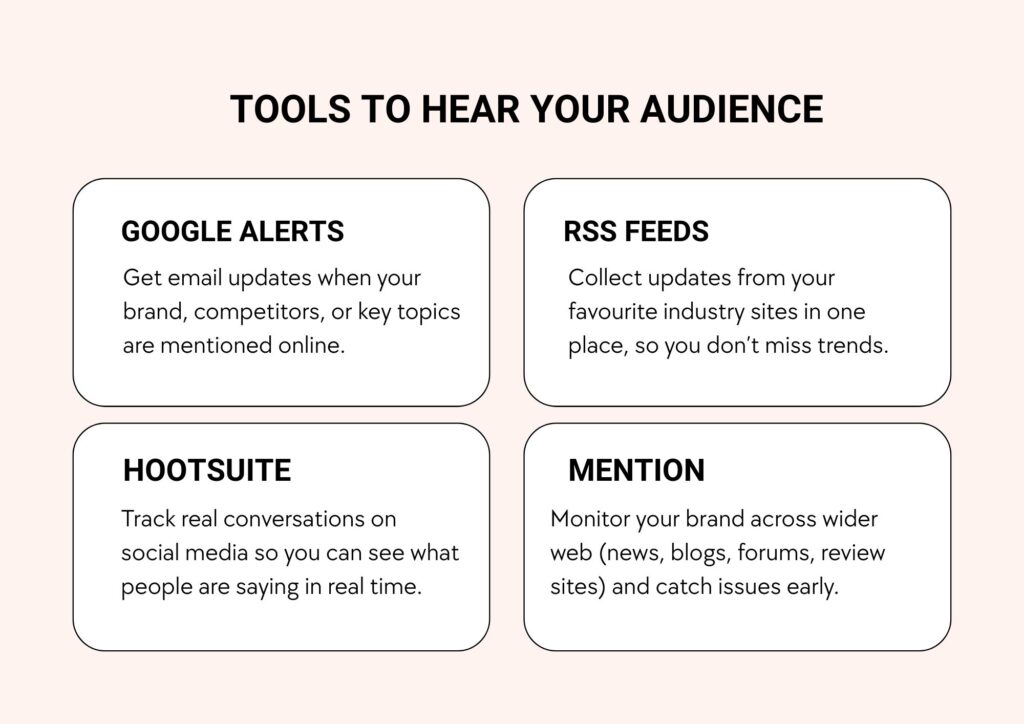
Google Alerts is a free tool from Google that helps you keep track of what’s being published online about a topic.
The way it works is simple: you choose a few keywords you want to monitor (your brand name, product name, competitor names, or common problems in your industry), and Google does the searching for you in the background. Whenever Google finds new pages that match your keywords, it sends you an email update. So instead of searching again and again, you get updates automatically.
Over time, you start spotting patterns like what people keep asking, what they’re confused about, which competitors are being mentioned, and where your brand is showing up online.
RSS feeds (one place for updates)
RSS sounds technical, but it’s simple.
It lets you “subscribe” to websites (blogs, news sites, industry publications). When they post something new, it appears in one place inside an RSS reader.
The real value is this: it gives you one central place to stay updated, instead of checking ten different websites one by one. Over time, RSS helps you build a steady “industry feed” for your work. You start noticing trends earlier, you see what competitors are talking about, and you understand what topics are getting attention before they become mainstream.
This matters because your customers don’t live in your brand bubble. Their expectations are shaped by what they read, watch, and hear in the market. RSS helps you stay close to that reality.
Hootsuite (social listening)
If you want to understand what people are saying on social media, you need social listening. Social listening means tracking real conversations happening on platforms like X (Twitter), Instagram, TikTok, and more, so you can understand what people are saying about your brand, your competitors, or your topic in real time.
It’s different from “posting content.” It’s about watching the market. It helps you pick up on things that traditional research misses, like the exact words people use when they describe problems, the emotions behind complaints, and the common questions people keep asking.
Tools like Hootsuite can help you track mentions and keywords across channels, so you’re not manually searching all day. It can also help you spot patterns, like when frustration is increasing, when a competitor is getting praised, or when a topic is suddenly trending. Hootsuite is a paid tool, but it offers a 30 day free trial.
Mention (brand monitoring across web + social)
Mention goes wider than just social media.
It helps you track brand mentions across social platforms and also across the wider web, like news sites, blogs, forums, and review websites. This is important because a lot of opinions are written outside Instagram and Twitter. People complain on forums. They review on Trustpilot. They post long stories on Reddit. And those posts often show up in Google search results and influence buying decisions.
Mention can alert you when something new appears, which is useful for catching problems early, responding faster, and seeing how people talk about your brand when you’re not in the room. It’s also paid, but it offers a free trial.
The main point
These tools help you hear the market clearly and consistently. So you’re not doing “research once a year.” You’re listening all the time, spotting patterns earlier, and improving as you go.
Once you’ve set up listening, the next step is to understand what people do when they land on your website.
Google Analytics 4
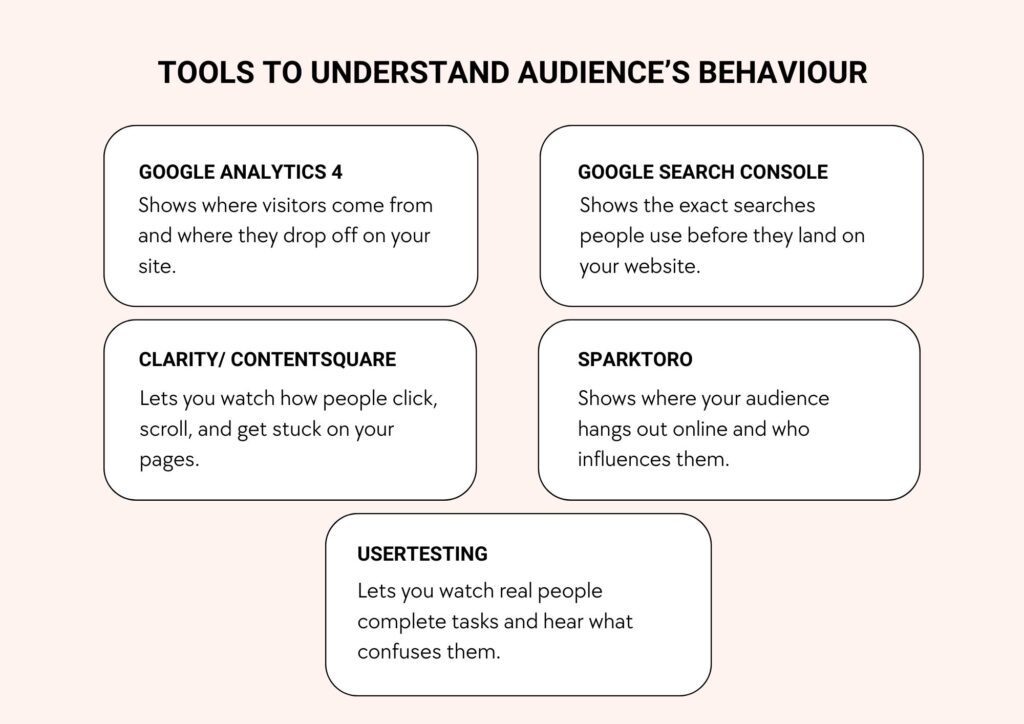
GA4 is a free tool from Google that helps you understand what people are doing on your website. It shows you where visitors are coming from (Google, social media, email, referrals), what pages they visit, and what actions they take.
The real value is that it helps you spot what’s working and what’s not. For example, you might notice people land on your homepage but leave quickly, or they reach your product page but never click “buy”, or they start checkout but don’t finish.
These drop-off points tell you where the friction is. Once you know where people are leaving, you can start improving the exact parts that are losing customers instead of guessing what the problem might be.
Google Search Console
Google Search Console is also a free Google tool, but it focuses on what happens before people even reach your website.
It shows you the exact words and questions people type into Google that lead them to you. You can see which search terms bring clicks, which pages are showing up in search results, and whether people are actually clicking when they see your site.
This is powerful because it reveals customer intent in their own words. It helps you understand what people are trying to solve, what they expect, and how they describe their problem.
Over time, Search Console also helps you spot opportunities, like topics people are searching for that you don’t cover yet, or keywords where you’re showing up but not getting clicks because your page title or content isn’t matching what people want. It’s one of the simplest ways to understand your audience at scale, because it’s based on real searches, not assumptions.
Heatmaps + session recordings
Sometimes you don’t just want data. You want to actually see what’s happening on your website. Heatmaps and session recordings let you watch real visitors in action. You can see where people click, how far they scroll, what they pause on, what they ignore, and what they keep going back and forth on.
This is useful because it shows you what people are actually reading, what they’re skipping, and how they behave when they’re deciding whether to buy, sign up, or leave. It’s one of the fastest ways to spot what’s working on a page and what needs improving.
There are a few tools that do this well. Microsoft Clarity is a great starting point because it’s free and gives you heatmaps and recordings without much effort. Hotjar does the same core job, but also adds built-in feedback tools, which is helpful when you want to ask users quick questions on the page. Contentsquare is the more advanced option, usually used by larger teams that want deeper journey analysis at scale.
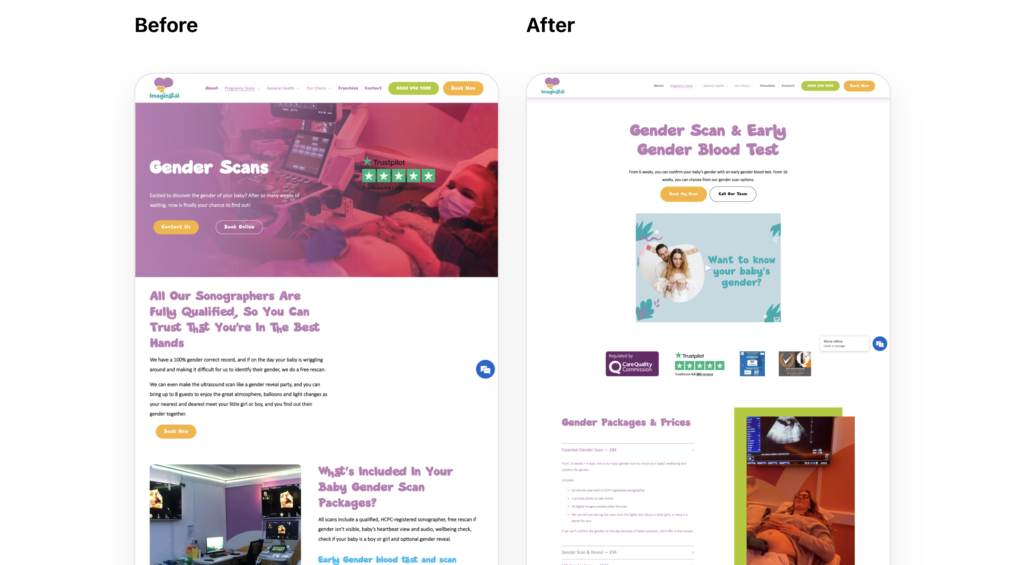
Honestly, this is my favourite way to learn because you’re not guessing, you’re watching real behaviour. We use Contentsquare at Imaginatal, and it’s one of the most useful tools I’ve seen for understanding how people actually experience a website. The key point is you don’t need all of them. Pick one and use it to understand what’s happening on your site in real life.
SparkToro
Sometimes the problem is you’re not even sure where your audience spends time online in the first place. That’s where SparkToro is powerful. It’s an audience research tool that helps you see what a specific audience reads, watches, listens to, and follows online, things like websites, publications, podcasts, YouTube channels, and social accounts that actually reach them.
The way you use it is simple: you start with an audience idea (for example, people who search for a keyword, people who visit a certain website, or people who use certain words in their bio), and SparkToro shows you patterns about that audience. It can show what they’re likely to search for, how they describe themselves, and which sources influence them.
This is useful because it helps you stop guessing where to market. Instead of posting everywhere, you can focus on the channels and communities that already have your audience’s attention. It’s also a great tool for finding influential voices, because it can surface the accounts, creators, and publications that your audience is most likely to follow.
SparkToro offers a free version and paid plans, so you can test it without committing straight away.
User Testing
User testing is simple: you give someone a task and you watch how they do it. For example: “Find the pricing,” “Book a ticket,” “Sign up,” or “Choose the right plan.” As they complete the task, you can usually see their screen and hear them speak, so you understand what they’re thinking in real time. This is powerful because people often get confused in places you never expected, and they’ll say out loud what feels unclear, what feels untrustworthy, or what doesn’t make sense.
You can do user testing in two main ways. The first is using a platform like UserTesting, where you describe the kind of person you want to test (your target audience), and the platform finds participants from its network. This is fast and useful when you want quick feedback. The second way is testing with your own audience by sending an invite link to real customers, newsletter subscribers, or community members. This is usually more accurate because these people understand your market and are closer to real buying behaviour.
User testing helps you improve your website and messaging in a very practical way. You learn what people actually notice, what they ignore, what they misunderstand, and what makes them hesitate. Instead of guessing or debating internally, you get direct insight from real people and you can fix the issues before they cost you customers.
2. Create a listening culture
Listening only works if it becomes a habit — not a one-time project.
A lot of brands make this mistake:
They have one team (usually marketing) doing all the listening, then “reporting” insights to everyone else.
The problem is simple:
When an insight comes from someone else, people often resist it.
But when a team hears the customer directly, it feels real — and they’re more likely to act on it.
So here’s the better approach:
Share the listening and learning responsibilities with the teams who benefit from them most.
That means each department should listen for what they can improve:
- Marketing can spot what people want, what language they use, and what messages hit or miss.
- Customer service can see complaints and confusion early, and fix responses before things blow up.
- Product development can notice feature requests, pain points, and why people switch brands.
- Operations can catch delivery issues, quality problems, or repeated process breakdowns.
- Finance can understand pricing complaints, refund patterns, and what customers see as “too expensive.”
When different departments have direct knowledge of customer experiences, it becomes much easier to fix issues before they get out of hand.
How to make this work (keep it simple)
You don’t need a big system. Start with two things:
1) Create one shared place for insights
A Google Doc, Notion page, Slack channel, or simple sheet.
One place where everyone drops what they’re seeing and hearing online.
2) Make listening part of the weekly routine
Do a 10-minute weekly check-in and ask:
- What are people complaining about?
- What are they confused about?
- What are they comparing us to?
And to keep it clear, use one simple format for each insight:
- What we saw
- Where we saw it (review, Reddit, TikTok, etc.)
- What it means
- What we’ll do next
That’s it.
A listening culture means the whole company stays connected to real customer reality, and problems get solved earlier, not after they become a crisis.
3. Invite consumer input
Listening to online conversations is vital.
But the next step is even more powerful: invite feedback on purpose.
A lot of brands avoid this.
They’re scared of reviews. Scared of complaints. Scared of “opening the door” to negativity.
But here’s the truth:
The more you invite feedback, the more you learn.
And the more you learn, the more control you actually have to improve.
When you avoid feedback, you don’t stay safe.
You just stay blind.
And when you’re blind, negative behaviour grows anyway, except now you don’t see it early enough to respond or fix it.
Simple ways to invite consumer input
You don’t need big research projects. You just need small, consistent feedback loops.
1) Use beta testing (let customers shape the product)
Big brands do this for a reason.
Before launching something fully, they test it with real users.
You can do the same, even as a small business:
- give early access to a new feature, product, or offer
- ask a small group to try it
- watch what confuses them
- fix the issues before the full launch
It’s one of the fastest ways to improve, because you’re building with customers, not guessing alone.
2) Make reviews and ratings easy
Reviews aren’t just for trust.
They are free insight.
They tell you:
- what people love
what annoyed them - what they expected but didn’t get
- what almost stopped them from buying
So don’t hide from reviews. Invite them.
If you have a website, add a simple ratings/review section.
If you sell on platforms, encourage customers to review there.
And if someone leaves a negative review, treat it like useful data — not an attack.
3) Create spaces where people can talk back
You can invite input through:
- comments and DMs
- polls and Q&A stories
- short feedback forms
- community groups
- small contests where people share their experience with your brand
The point is not to chase praise.
The point is to create a habit of listening and learning.
4. Determine who your most influential online voices are
Not every voice online matters the same.
In every market, there are a few people who genuinely shape opinions and buying decisions.
They might be big creators but they can also be niche reviewers, bloggers, newsletter writers, podcast hosts, or community admins.
Your job is simple: find the voices that influence your audience most, and listen to them closely.
How to do it (simple and practical)
1) Find where the real conversation is happening
Don’t start with follower counts. Start with behaviour.
Search the way your customers search, like:
- “best [your product/category]”
- “[your brand] review”
- “[competitor] vs [competitor]”
- “is [product] worth it?”
- “problem with [product]”
You’ll quickly notice the same names, pages, and communities popping up again and again.
2) Separate real influence from noise
Some people post a lot, but don’t change decisions.
Look for voices that:
- get meaningful comments (not just emojis)
- start discussions
- get referenced by others
- show up repeatedly across search results and communities
3) Do a quick credibility check
Before you take someone seriously, check if they’re unbiased.
Ask yourself:
- Are they always sponsored?
- Do they review competitors too?
- Are they connected to a competitor or being paid to push a certain side?
- Do they have a history of honest opinions?
You don’t need perfection, you just want to avoid building strategy on a paid or biased voice.
4) Build a relationship and involve them
Once you identify the right voices, don’t just watch them. Engage with them.
You can:
- reply thoughtfully to their posts
- invite them to give feedback
- offer early access (beta testing)
- ask them to review new products or features
- keep them in the loop with updates (launch news, previews, invites)
The goal isn’t to chase influencers for attention.
It’s to stay close to the voices that shape consumer opinion — so you can learn faster and make better decisions.
The main point
You don’t need perfect research. You need consistent listening.
Pick one tool from this article, set it up this week, and spend 15 minutes every week reviewing what you’re learning.
That habit alone will make your marketing sharper than most brands.