How to Make Your Brand Different in a Way People Actually Care About
When P&G set out to create a dishwashing liquid, they didn’t start with a clever slogan. They started by understanding their audience. They went into homes across America and watched people wash dishes and what they saw was simple: grease was the enemy.
Once grease got into the dishwater, it spread, it clung to everything. That one observation became the difference. The insight went to the scientists, the formula followed, and Dawn was born. The functional promise wasn’t fluffy. It was specific and meaningful. Dawn doesn’t just clean. It cuts through grease so dishes get done faster.
And P&G captured that promise in a clean, easy sentence people could understand: “Dawn takes grease out of the way.” For years, that idea helped Dawn stay at the top, because it wasn’t trying to be everything. It owned one problem that people genuinely cared about.
But great brands don’t win once and stop. Over time, more dishwashing liquids showed up and with them came more new and improved promises. The problem with feature-based claims is that they rarely stay exclusive for long. Sooner or later, another brand can match them, copy them, or shout an even louder version of the same idea. P&G knew that if Dawn stayed only at the functional level, competitors would keep closing the gap. So they did what smart marketers do. They didn’t abandon the original promise. They moved it up the ladder, just enough to keep it fresh and still believable.
They asked a better question: why is greasy dishwater so annoying in the first place? Not just “because it’s greasy,” but because it slows you down. It keeps you stuck in the kitchen. It steals your time. Instead of repeating “cuts grease” forever, Dawn began to express the same benefit from a human angle. If grease is out of the way, you get out of the kitchen faster, and you get back to your life, family time, a book, a quiet evening, anything you’d rather be doing than scrubbing.
What Makes Brands Last
Best brand organisations know this:
A brand promise that goes beyond pure functionality lasts longer. A better mousetrap is only a better mousetrap until something even better comes along. That’s why differentiating your brand on a functional benefit is not just good, it’s a requirement. But when you take that benefit up the ladder, you give it more shelf life. It becomes flexible, scalable, and sustainable.
Because look around. Supermarkets are packed with “new” and “improved.” Online, the clutter is even worse. Brands don’t just compete on shelves anymore, they compete inside the same screens, the same feeds, the same search results. Everything sits in the same framework, which makes standing out genuinely hard. That’s why brands have to establish relevant differentiation. Not just something different, but something different that actually matters to the people you want to win.
What A Brand Really Is
A brand is a promise. It’s the understanding between a company and a consumer that a product or service will perform the way people expect it to. That promise can be functional, what the product does, how it tastes, how it smells. It can be emotional, how it makes you feel, more confident, healthier, calmer. Or it can be about the total experience, like what you expect when you fly an airline or stay in a hotel.
Branding is how that promise is expressed. It’s the packaging, the ads, the website, the emails, and even the customer service. Over time, branding becomes what people remember and what makes them choose one brand over another.
There’s a common belief that if a company spends enough time and money making people aware of a product, people will automatically buy it. The most successful companies know this is a misconception. They know that to succeed, a brand has to stand out from its competitors and give people a clear reason to prefer it. If your brand isn’t truly different, or if that difference isn’t relevant to your audience, all the noise and awareness in the world won’t matter.
Relevant differentiation
Relevant differentiation is where two things meet:
- Differentiation: how your brand is different from competitors.
- Relevance: why that difference actually matters to your audience.
You need both. If you’re different but it doesn’t matter, people won’t care. If you matter but you’re not different, you’re replaceable. Dawn is a simple example. It didn’t just say “we clean dishes.” It owned a specific frustration, grease, and made that the reason to choose it. That’s why the strongest brands have a high degree of both differentiation and relevance.
How Three Brands Used Relevant Differentiation to Win
Kleenex: “Let It Out”
One of my favourite examples is Kleenex, because tissues are one of the most common, hard to differentiate products. The functional benefit is basic: it helps with sneezes, mess, and germs. So instead of trying to win with yet another softer/stronger/better claim, Kleenex climbed up the ladder in a way that still fit the product. Tissues aren’t just for colds. They’re there for the moments people “let it out”, tears from laughing too hard, tears at a wedding, tears at a funeral, the awkward tears in a therapist’s office even the dirt you wipe off a kid’s face after a big win.
That idea became the “Let It Out” campaign. Kleenex took a comfortable blue couch on tour and asked people questions that pulled out real emotion, right there on the street. Things like: “What would you say to your mum if she were here?” “What makes you laugh out loud?” “How far would you go for your hometown sports team?” The reactions were the point. People stopped, sat down, opened up. Some laughed, some cried, some surprised themselves with what they shared.
And Kleenex didn’t let it end there. Those moments were recorded and used across channels. The best responses became the basis for TV spots, and online the campaign went further. People could watch the videos, share them, and even upload their own “Let It Out” stories, which helped the message spread through digital and platforms like YouTube. That’s how Kleenex used relevant differentiation properly: it took a commodity product, stayed close to its functional role, and built an emotional connection that made the brand feel more human and more memorable.
Dove: ‘’Real Beauty’’
Dove is a good example of a brand that started with a strong functional promise, then climbed up the ladder in a way people could actually believe. For years, Dove stood out because it didn’t dry skin the way soap did. The message was simple and specific: it has ¼ moisturising cream and that helped make the brand feel more caring and skin-friendly than a typical bar.
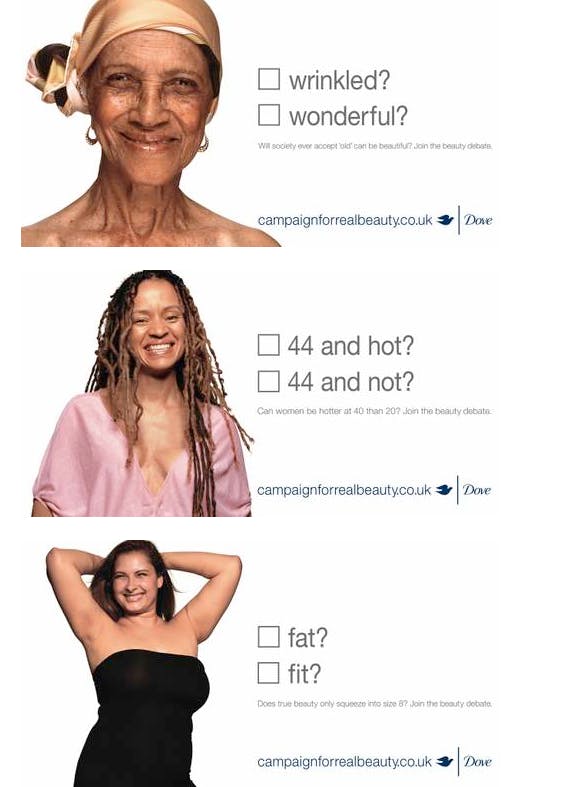
But Dove also knew a functional claim, no matter how true, is easier for competitors to challenge over time. So the team looked for a higher level promise, something each product could represent beyond “it works.” That search led them to a bigger tension in the world of beauty: unrealistic standards that women were expected to meet. In Dove’s research, one number stood out. Only 2% of women said they considered themselves beautiful.
That insight became the foundation for the Campaign for Real Beauty. Instead of using polished, ultra-thin models, Dove put ordinary women on billboards and in print ads, women who looked like real people, not “perfect” ideals. Then they did something clever. The billboards didn’t just show images, they invited participation. Viewers were asked to vote on questions like whether the woman was “oversized or outstanding,” using a toll free number. The results updated in real time on the billboards, which instantly pulled people into the conversation and got them talking. Dove was delighted by how strongly people reacted, because the campaign wasn’t just being seen, it was being discussed.
Later, the Evolution video added another layer. It showed a time-lapse transformation of an ordinary looking woman into a “perfect” beauty image using makeup, styling, lighting, and heavy retouching. It was originally made for internal use but once the team realised the internet could amplify the debate, they posted it online. It spread fast, because it made the point in seconds and gave people something they wanted to share.
Liberty Mutual: Responsibility
Liberty Mutual had a real problem that a lot of “commodity” categories have. In its business side, the company had a deep heritage in workers’ compensation and a long reputation around workplace safety and risk control. That matters to B2B customers who care about reducing injuries, managing risk, and getting expert support. But on the consumer side, people shopping for home or car insurance aren’t usually looking for “safety expertise.” They want to feel protected, treated fairly, and not taken advantage of.
So Liberty Mutual found a bridge that didn’t throw away its heritage, but also made sense to everyday consumers. It turned out it was right under their noses in their mission statement: responsibility, the idea of doing the right thing.
The centrepiece was a series of TV ads showing small acts of doing the right thing that ripple forward. One of the best ad starts with a man noticing a toy on the ground and returning it to a stroller. The mother then “pays it forward” by stopping a coffee from spilling, and the chain continues as one good deed inspires the next. The voiceover lands the idea with the line: “When it’s people who do the right thing, they call it being responsible. When it’s an insurance company, they call it Liberty Mutual. Responsibility. What’s your policy?”
What made this more than a nice commercial was the reaction and the follow-through. Liberty Mutual said the early “pay it forward” ad got an overwhelmingly positive response, with people writing letters and emailing about how it made them feel. Then they used digital to extend the idea into The Responsibility Project, an online platform built around stories, short films, and discussion about “doing the right thing,” so the campaign could live beyond a 30-second spot.
Consumers will almost never hand you the brand idea in a neat sentence. No woman is going to walk into a store and say, “I can’t relate to the unrealistic beauty standards in advertising, so I want a brand that redefines beauty.” Just like nobody says, “I want a dishwashing liquid that eliminates grease from my dishwater”.
What people do tell you, directly and indirectly, is how they live, what annoys them, what makes them insecure, what makes them feel seen and what makes life easier. Your job is to listen properly, do the research and read between the lines until you find the truth underneath the noise.
The best brand ideas usually come from something simple and universally true, something hiding in plain sight. That’s how you create a point of difference that’s not only different, but relevant, and that’s how you earn attention for the right reason.
How to find relevant differentiation
- Look for what’s hiding in plain sight
Sometimes the strongest point of difference is obvious, but everyone ignores it because they’re too busy copying category norms. Even if the “what” is the same as everyone else, the “how” can be your advantage. Execution can be the differentiator. - Ask your customers (properly)
Use digital tools to listen, not just to broadcast. Read reviews, run polls, collect feedback, build small communities, and pay attention to the words people use. Customers won’t hand you the solution, but they will tell you their frustrations, habits, and what they wish was easier. - Go back to the customer journey
Look at the full experience, not just the product. Where do people hesitate, get confused, feel delighted, or feel let down? If you embed your promise in every touchpoint, you don’t just “say” you’re different, you make people feel it, and that’s much harder for competitors to copy. - Ladder it up to an emotional promise
In today’s world, feature-based differentiation is fragile. One brand adds a feature, another matches it next month. But when you express the benefit from a human angle, what it means in someone’s life, you become more memorable. Just keep it connected to the product truth. - Find a different ladder if everyone sounds the same
If every brand in the category is chasing the same emotional space, “confidence,” “freedom,” “premium,” you can stand out by choosing a different emotional benefit that still fits the product and transforms how people see the category.
Once you have that clear, attention becomes easier. You’re not trying random tactics. You’re using attention to spotlight one simple, relevant difference, again and again.