From 134 Search Campaigns to 29: Rebuilding a Cleaner, More Scalable Google Ads Structure
How I rebuilt a fragmented Google Search account into a clearer structure based on location, service category and search intent.
Project overview
This project involved restructuring Google Search campaigns for a multi-location healthcare business.
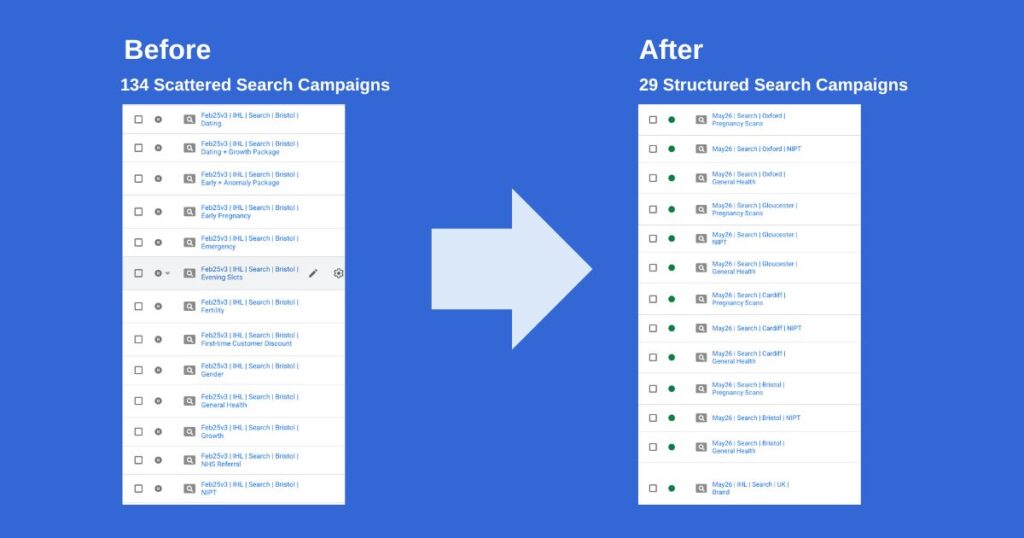
When I audited the account, Search had 134 active campaigns. The account was generating conversions, with a 5.56x ROAS and £20.05 CPA, but the campaign structure had become increasingly fragmented.
Many closely related services, offers, packages and booking angles were running as separate campaigns. Similar campaign structures were also being repeated across locations, making the account harder to manage, report on and optimise.
The challenge wasn’t simply to reduce the number of campaigns. It was to create a structure that was simpler to manage without losing the targeting detail needed for different services and search intents.
I redesigned the Search structure around three principles:
Campaign = Location + Main Service Category
Ad Group = Specific Service + Search Intent
The result was a new structure of 29 Search campaigns — a 78% reduction in campaign count — while retaining service level targeting through ad groups.
The challenge
The account had grown organically over time, resulting in a large number of closely related campaigns.
For example, different scan types, services, offers and booking angles were often separated into individual campaigns rather than being grouped into a logical service structure.
This created several challenges:
- 134 active Search campaigns
- Similar campaign structures repeated across locations
- Related services split across multiple campaigns
- Offers and booking angles creating additional campaign complexity
- Less flexibility when managing budgets
- More difficult reporting
- More time-consuming optimisation
- No consistent framework for scaling Search across locations
Search was already converting, so I didn’t want to restructure the account simply for the sake of reducing campaign numbers.
The objective was to reduce unnecessary structural complexity while making the account easier to control, understand and optimise.
Key issues I focused on
- Too many active Search campaigns
- Same campaign structure repeated across locations
- Similar services split into separate campaigns
- Offers and booking angles running as separate campaigns
- No clear structure by service category
- Search intent not grouped clearly enough
- Harder budget control
- Harder reporting
- Harder optimisation
- Search not set up strongly enough to support long-term growth
The Audit
I reviewed the existing Search structure to understand how campaigns were divided across locations, services, offers and search themes.
I also analysed historical Search-term data and relevant PMax search insights to understand what users were actually searching for.
This helped me identify opportunities to consolidate closely related campaigns while maintaining meaningful keyword and ad-group-level targeting.
The key question was:
What needs its own campaign, and what can be managed effectively within an ad group?
This became the foundation for the new structure.
The New Campaign Structure
Instead of creating a separate campaign for every service variation, I grouped related services into broader campaign categories.
New structure
Campaign
Location + Main Service Category
↓
Ad Group
Specific Service / Search Intent
For example:
Location | Pregnancy Scans | Search
- Pregnancy Scan Core
- Early Pregnancy
- Gender Scan
- 3D / 4D Scan
Location | Blood Tests | Search
- Blood Test Core
- General Health Blood Tests
- Fertility & Hormones
- Cancer & Genetic Screening
- Allergy
- Infection & Immunity
This approach allowed me to consolidate campaigns without losing the ability to target specific services and search themes.
Brand and Non-Brand Structure
I also separated different types of search intent more clearly.
Brand and non-brand traffic were managed separately so that existing brand demand did not become mixed with service-led acquisition.
Where appropriate, I added brand terms as negative keywords to non-brand campaigns to reduce overlap and improve reporting clarity.
A separate UK-wide brand campaign was created because the intent behind these searches was fundamentally different.
UK | Brand Search
- Brand Core
- Brand + Location
- Booking Intent
- Reviews
- Brand Misspellings
Keyword & Search-Term Strategy
I didn’t build the new structure from assumptions alone.
I used historical Search-term data from existing campaigns alongside relevant PMax search insights to identify real search behaviour and inform the new keyword themes.
This helped shape:
- Campaign categories
- Ad groups
- Keyword themes
- Negative keyword opportunities
- Search-intent groupings
The goal was to create a stronger connection between:
User search → Keyword theme → Ad group → Ad message → Landing page
This also helped ensure that closely related search terms were grouped logically rather than spread across unnecessary campaigns.
Ad Messaging & Assets
As part of the restructure, I also reviewed the ad messaging to make it more relevant to the service and location being targeted.
I worked on:
- Responsive Search Ad headlines
- Descriptions
- Sitelinks
- Structured snippets
- Image assets
- Location assets
Rather than relying on generic messaging across campaigns, I aligned the copy more closely with the service category, search intent and the keywords.
This helped create a clearer journey from the user’s search query through to the relevant service and landing page.
Implementation & Bulk Upload
Once the new architecture was planned, I built and implemented the campaigns using Google Ads bulk uploads.
This allowed me to apply the new structure consistently across multiple locations while reducing manual setup time.
After implementation, I carried out QA checks across:
- Campaign names
- Ad group names
- Campaign settings
- Location targeting
- Keywords and negatives
- Ads and assets
- Campaign status
- Policy status
Because this was a healthcare account, some ads and keywords also required additional policy checks and reviews before running.
The campaigns were monitored after launch to identify any setup issues and ensure the new structure was functioning as intended.
Results
134 → 29 Search Campaigns
The restructure reduced the number of active Search campaigns by 78% while retaining service-level targeting through a clearer ad group structure.
Structural outcomes
Before
134 Search campaigns
Fragmented service and offer structure
Repeated campaign setups across locations
More complex budget and reporting management
After
29 Search campaigns
Location + service category structure
Specific services managed through ad groups
Clearer brand/non-brand separation
More consistent campaign architecture across locations
The new structure created a stronger foundation for ongoing optimisation and made it easier to understand where budget, search intent and service performance sat within the account.
Conversions also started coming through within the first few days of launch. At this early stage, I treated this as an initial positive signal rather than attributing performance changes directly to the restructure, and continued monitoring the campaigns before drawing longer-term performance conclusions.
Key Takeaway
The objective wasn’t simply to have fewer campaigns.
It was to build a Google Search structure that could scale across locations without creating unnecessary campaign complexity.
By moving from 134 fragmented campaigns to 29 structured campaigns, I created a clearer framework for managing services, search intent, budgets, reporting and future optimisation.
The result was a Search account that was simpler to manage, more consistent across locations and better structured for future growth.