Full Google Search Ads Rebuild: 3-Month Results After Restructuring Campaigns, Keywords and Ads
How a full Google Search rebuild improved campaign control, reporting and performance over three months.
Project overview
This case study is a follow-up to my Google Search restructure project.
In the first case study, I explained how I rebuilt a fragmented Search setup from 134 active campaigns into 29 structured campaigns.
This case study looks at what happened after the rebuild had time to run.
The work was not just a campaign structure change. It was a full Search rebuild. I updated the campaign structure, ad groups, keywords, negative keywords, headlines, descriptions, sitelinks, structured snippets, image assets and location assets.
The goal was to make Search easier to manage, easier to report on and better aligned with how people were actually searching.
Before the restructure, Search had a ROAS of 5.56x and a CPA of £20.05.
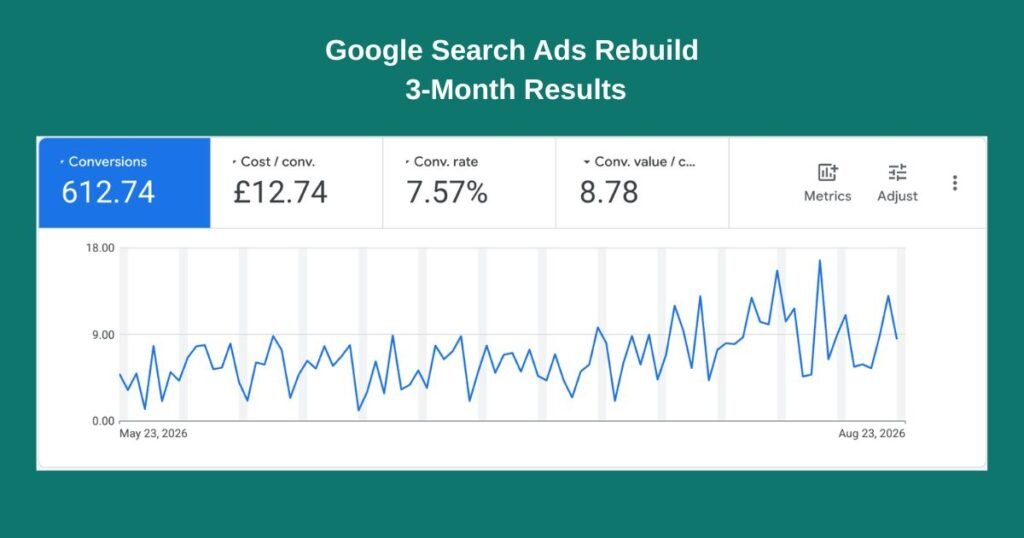
After three months, the rebuilt Search campaigns delivered:
| Metric | 3 month result |
|---|---|
| Conversions | 612.74 |
| CPA | £12.74 |
| Conversion rate | 7.57% |
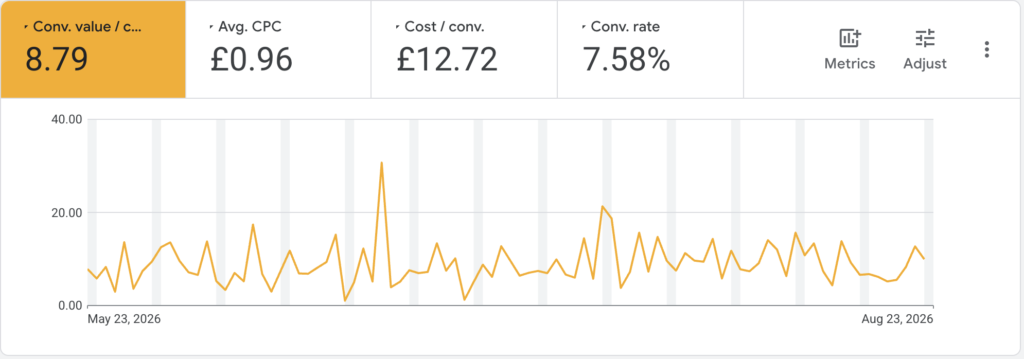
| ROAS | 8.78x |
This means CPA was around 36% lower than the old Search benchmark, while ROAS was around 58% higher.
No customer or patient data is included in this case study.
What changed before the results
Before measuring the results, the Search account had already been rebuilt from the ground up.
The old structure had too many campaigns split by small services, offers, packages and booking angles. The new structure grouped campaigns by location and main service category, with more focused ad groups inside each campaign.
I explain the full restructure in the first part of this case study: From 134 Search Campaigns to 29.
In short, the rebuild included:
- A cleaner 29-campaign Search structure
- New ad groups based on service type and search intent
- Keyword themes based on Search and PMax search-term insights
- Brand terms added as negative keywords in non-brand campaigns
- New headlines and descriptions
- Updated sitelinks and structured snippets
- Image assets and location assets
- Bulk uploads to rebuild the account consistently
- Policy checks after launch
This gave the account a much cleaner base to work from before the three-month results were measured.
3-month performance results
Across the selected 3 month period, the rebuilt Search campaigns generated 612.74 conversions.
| Metric | Before rebuild | 3-month result | Change |
|---|---|---|---|
| CPA | £20.05 | £12.74 | 36% lower |
| ROAS | 5.56x | 8.78x | 58% higher |
The overall conversion rate was 7.57%.
This showed that the new Search setup was not only easier to manage but also performing more efficiently over time.
The main improvement was not just that the campaigns generated conversions. Search became easier to understand and optimise because the structure was clearer.
What happened over the three months
Performance was monitored regularly after launch.
The campaigns did not stay untouched after the rebuild. I continued checking performance, reviewing search terms, adding negative keywords, pausing weaker keywords, checking ad performance and making changes where needed.
As the campaigns collected more data, we made decisions based on what was actually happening in the account.
Some areas performed strongly and were protected. Some areas needed more review. Budgets were also adjusted where needed.
This was important because the rebuild gave the account a better structure but the ongoing optimisation helped improve how that structure performed in practice.
What improved
The biggest improvement was control.
The account became easier to manage because campaigns were no longer scattered across too many small service variations.
Reporting also became clearer. It was easier to understand performance by:
- Location
- Service category
- Search intent
- Brand vs non-brand traffic
- Campaign and ad group level
The new structure also made optimisation easier.
Search terms were easier to review. Negative keywords were easier to manage. Ad copy could be improved by service and location. Budget decisions were easier to make because the account had a clearer structure behind it.
What I learned
This project showed me that Google Search performance depends on much more than keywords alone.
The structure matters. The ad groups matter. The copy matters. The assets matter. The landing page connection matters. Reporting also matters because you need to understand what is working before you can improve it.
This was not about reducing campaigns just to make the account look cleaner.
It was about building a Search setup that made sense, could be managed properly and could improve over time.
Outcome
After three months, the rebuilt Search campaigns showed stronger performance than the old Search benchmark.
CPA improved from £20.05 to £12.74, and ROAS improved from 5.56x to 8.78x.
The selected 3 month view also showed 612.74 conversions and a 7.57% conversion rate.
The account became easier to report on, easier to optimise and easier to manage across locations and service categories.
For me, this project showed the value of rebuilding an account properly instead of making small changes on top of a messy structure.
A cleaner structure gave Search a stronger foundation, and ongoing optimisation helped turn that structure into better performance.